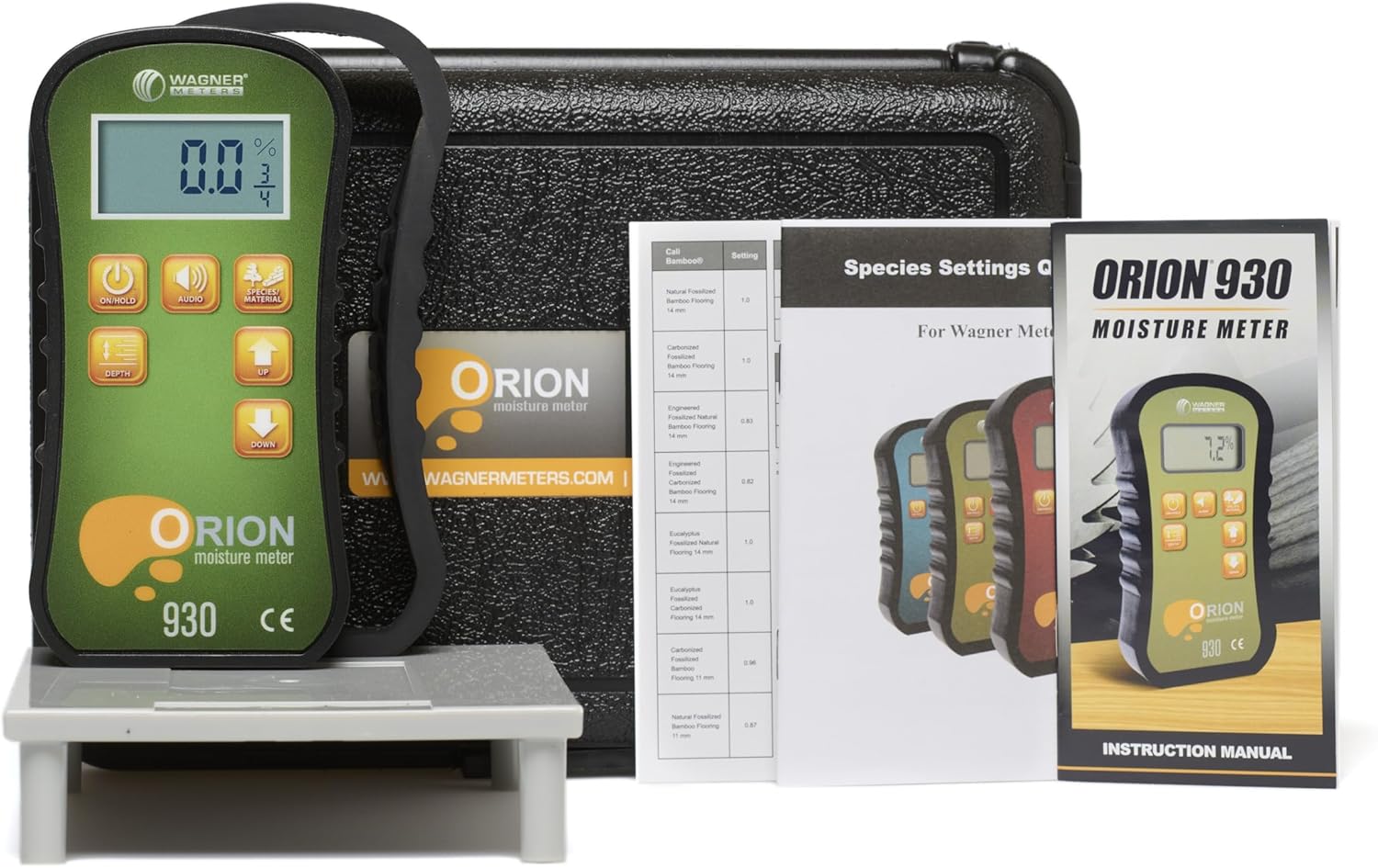
Wood and water have a complicated relationship. Wood is hygroscopic — meaning it continuously absorbs and releases moisture from the surrounding air — and it changes dimension as it does. Lay a plank when it’s wetter than your home environment, and it will shrink after installation, opening gaps between boards. Lay it when it’s too dry, and it will expand and cup or buckle. A moisture meter is the handheld device that tells you where your wood stands before you commit to installation. It reads the percentage of water weight relative to the board’s dry weight — a number called moisture content (MC) — and it takes about thirty seconds per board to use. That one number, measured consistently across your material and your subfloor, is the single most reliable predictor of whether your floor performs beautifully for decades or fails within its first heating season. This guide will show you how to read those numbers correctly, which meter type to choose for your situation, and — critically — how to make the math work when the numbers don’t line up.
| EDITOR'S PICK[Orion® 930 Pinless Wood Moistur…](https://www.amazon.com/dp/B07K6SDZQG?tag=greenflower20-20) | Mid-tier[Lignomat Mini-Ligno E/D Pin Moi…](https://www.amazon.com/dp/B00PB68H4O?tag=greenflower20-20) | Budget pick[General Tools MMD4E Digital Moi…](https://www.amazon.com/dp/B00275F5O2?tag=greenflower20-20) | |
|---|---|---|---|
| Measurement Type | Pinless | Pin | Pin |
| Depth | Dual Depth | — | — |
| Calibration | On-site (included) | — | — |
| Display | — | — | Backlit LCD |
| Price | $525.00 | $111.48 | $37.79 |
| See on Amazon → | See on Amazon → | See on Amazon → |
What the Numbers Actually Mean — and Why the Gap Is What Kills Floors
Moisture content is expressed as a percentage. The National Wood Flooring Association (NWFA) Installation Guidelines and Performance Rating Standards state that most hardwood flooring should be installed at an MC between 6% and 9% in most U.S. climate zones — though the acceptable target varies by region (arid Southwest climates trend toward 6–7%; humid Southeast climates may allow up to 10–11%). The magic isn’t hitting any single number; it’s closing the gap between your flooring’s MC and your subfloor’s MC.
The NWFA’s governing rule: The difference between wood flooring MC and subfloor MC should not exceed 4 percentage points at installation. Wide-plank floors — anything over 5 inches, including the European white oak slabs that are currently commanding $12–$20 per square foot from suppliers like Carlisle Wide Plank Floors — require an even tighter tolerance because wider boards amplify movement across their face. Some installers working with 7-inch or wider planks hold to a 2-point differential.
By the Numbers
| Floor Type | Recommended MC at Install | Max Differential (Floor vs. Subfloor) |
|---|---|---|
| Solid strip (under 3”) | 6–9% | 4 points |
| Solid wide-plank (5”+) | 6–9% | 2–3 points |
| Engineered hardwood | 6–11% | 4 points |
| Exotic species (ipe, wenge, teak) | 7–10% | 3–4 points |
Fine Woodworking’s guide to wood movement makes the underlying physics plain: a flat-sawn red oak board at 12% MC that dries to 7% MC after installation in a heated home will shrink approximately 1% across its face width. On a 4-inch board, that’s a 1/16-inch gap — noticeable but livable. On a 7-inch plank, it opens to over 1/8 inch — a genuine warranty-voiding failure that no finish can hide.
Pin vs. Pinless: Choosing the Right Meter for Your Material
There are two meter technologies on the market, and they are not interchangeable for every application. Understanding what each one actually measures is the fastest way to avoid a bad reading.
Pin-Type Meters
Pin meters drive two small metal probes into the wood surface and measure electrical resistance between them. Because water conducts electricity and dry wood does not, resistance drops as MC rises. The reading is localized — it tells you the MC at the exact depth the pins penetrate, typically 3/16 to 5/16 inch.
Best for: Subfloor moisture checks (concrete, OSB, plywood), verifying surface vs. core moisture gradients, and spot-checking boards you suspect of having a wet core. On prefinished hardwood, pin meters require that you sacrifice a test board or measure an unfinished edge — the factory finish creates a false high-resistance reading.
Limitation: Each pin insertion leaves a small mark. On figured maple or hand-scraped walnut destined for prominent areas, that’s a real concern. Experienced installers typically pin-test the first and last boards of each bundle, plus any visually suspect pieces in the middle.
Pinless (Electromagnetic) Meters
Pinless meters send an electromagnetic field 1/4 to 3/4 inch into the wood and read the dielectric properties of the material — water content changes how the field propagates. No marks, rapid scanning, and you can sweep an entire carton in minutes.
Best for: Screening large quantities of flooring quickly, checking prefinished boards without surface damage, and monitoring acclimation progress across a staging area. This Old House’s guide to moisture meters notes that pinless models are the preferred choice for contractors who need to process high volumes of material before installation day.
Limitation: Pinless meters are sensitive to density variation. Exotic species like wenge, ipe, and teak — all significantly denser than domestic oak — can produce false readings unless you manually input a species-correction factor. Most mid-range and professional-grade meters include a species correction library; budget models often do not. If you’re sourcing figured teak or padauk from specialty dealers like Hearne Hardwoods or Bell Forest Products, verify that your meter has a correction factor for the specific species, or cross-reference against a pin reading.
The Hybrid Approach Most Pros Use
Pinless for volume screening. Pin for confirmation on questionable boards and for all subfloor readings. The two methods cost roughly $30–$80 (entry) and $80–$250 (professional grade with species correction) respectively based on aggregated retail pricing in early 2026. Owning one of each class costs less than the labor to re-sand and refinish a floor that failed because of a skipped measurement.
Reading Your Subfloor — the Step Most DIYers Skip
Your flooring’s moisture content at delivery is only half the equation. The subfloor sets the equilibrium target your flooring will eventually reach, and it has its own moisture story — one that’s often more volatile than the lumber itself.
Concrete subfloors require a different measurement method altogether. Concrete MC is not the same as wood MC, and a pin meter reading of 4% on concrete does not mean it’s dry enough for hardwood. The NWFA recommends either a calcium chloride test (which measures vapor emission rate in pounds of water per 1,000 square feet per 24 hours — acceptable threshold is typically 3 lbs or less) or in-situ relative humidity probes drilled into the slab, which should read below 75–80% RH depending on the adhesive system used. Pin meters used directly on concrete give you a relative indicator, not a calibrated number; treat those readings as a screening flag, not a go/no-go decision.
Wood subfloors (OSB, plywood) can be read with either meter type, but pin meters are strongly preferred because subfloor surfaces are not finish-protected and you can drive the pins to depth without consequence. Wood Magazine’s coverage of moisture content and wood stability recommends taking readings in a grid pattern — at minimum one reading every 20 square feet — because subfloor moisture is rarely uniform. Hot spots near exterior walls, plumbing chases, and crawl space penetrations are predictably wetter than field areas.
Practical checkpoint: Before acclimation begins, read the subfloor. If subfloor MC exceeds flooring MC by more than 4 points, starting the clock on acclimation without addressing the root cause (vapor barrier gaps, crawl space humidity, inadequate HVAC) means you’re acclimating your flooring to a problem environment — not to the building’s actual long-term equilibrium.
Acclimation: What It Is, How Long It Takes, and When the Clock Starts
Acclimation is the process of allowing delivered wood flooring to adjust its MC to the conditions of the space where it will live permanently. It is not optional, and it is not complete when the wood “looks fine.” It is complete when the meter confirms equilibrium.
The NWFA’s installation standards specify that acclimation should occur in the actual installation space — not a garage, not a warehouse, not an adjacent room — with the home’s HVAC system running at expected occupancy conditions (typically 60–80°F and 30–50% relative humidity). Boxes should be broken open and boards cross-stacked with spacers to allow air circulation on all faces.
Time estimates by species and starting MC:
- Domestic species (oak, maple, cherry) delivered near target MC: 3–7 days
- Domestic species delivered significantly above target: 10–21 days
- Tropical exotics (ipe, Brazilian cherry, teak): 2–5 days for thin engineered stock; solid exotics may require 3–4 weeks depending on starting MC and dimensional thickness
These ranges come from NWFA guidelines and are treated as minimums, not guarantees. Measure, don’t guess. A meter reading taken at day 3 and again at day 7 that shows movement of more than 1 point means acclimation is still active — keep waiting. Two consecutive readings 48 hours apart that are stable within 0.5 points signal you’ve reached equilibrium.
The Decision Rule: If X, Then Y
You have a pending installation — flooring delivered, subfloor prepped, contractor scheduled. Here is the framework:
If flooring MC and subfloor MC are within 2 points: You’re clear to install. Document the readings in writing and photograph them. This date-stamped record is your warranty evidence if a performance issue surfaces later.
If the gap is 3–4 points: Continue acclimation in the installation space. Re-measure every 48–72 hours. Do not install until the gap closes. Notify your contractor now so the schedule can flex — this is a far cheaper conversation than a failed floor.
If the gap exceeds 4 points or subfloor MC exceeds 12% on a wood subfloor: Stop. Identify and remediate the moisture source before any flooring goes down. Common culprits include unvented crawl spaces, failed vapor barriers, plumbing leaks, or insufficient post-construction drying time. No premium species — not wide-plank white oak, not hand-scraped walnut, not FSC-certified mahogany — will perform reliably installed over an unresolved moisture problem. The flooring will fail, and in most cases the warranty will be void because the installation conditions were outside specification.
If you’re working with exotics over 50 on the Janka scale (Janka is a hardness rating — it measures the force required to embed a steel ball halfway into a wood surface, used as a proxy for density and hardness): use a species-corrected pinless meter or cross-reference every batch with a pin reading. Dense exotics produce the most unpredictable electromagnetic meter readings and the highest consequences for an MC miss, because their dimensional stability, while often superior to domestic species, is directional — they move differently across radial versus tangential grain faces.
A moisture meter costs less than one square foot of premium wide-plank oak. The floor it protects costs thousands. Run the numbers every time.