Polyurethane is a clear protective coating — think of it as a tough plastic shell — that gets brushed or rolled onto hardwood floors to shield the wood from scratches, moisture, and daily foot traffic. If you’re refinishing white oak floors, installing hand-scraped walnut, or maintaining a prefinished engineered floor that needs a refresher coat, the finish you choose will determine how the floor looks in ten years as much as the species you selected. This guide is built for the reader who already knows they want polyurethane — not an oil or wax system or a penetrating hardener — but is staring down the oil-based versus water-based choice, trying to decode sheen designations, and wondering what this actually costs per square foot once labor, dry time, and recoat cycles are factored in. The math is real, the tradeoffs are named, and the decision rules are explicit.
Oil-Based vs. Water-Based: The Core Tradeoff Matrix
This is where most buyers get stuck, because both finish types are polyurethane — the chemistry is not completely different, but the carrier solvent is, and that single variable cascades into nearly every practical consideration you care about.
Oil-Based Polyurethane
Oil-based polyurethane uses mineral spirits or naphtha as its solvent. The finish cures through oxidation — a slow chemical reaction with air — which means it takes 18–24 hours or more between coats and 72–96 hours before light foot traffic. The upside: oil-based poly deposits a thicker mil (thousandths of an inch of build per coat) and imparts a warm amber tone that many buyers describe as the classic hardwood look. As documented in Fine Woodworking’s “Finishing Floors: Choosing the Right Topcoat,” a standard three-coat oil-based application builds approximately 3–4 mils of dry film thickness, which is meaningful for long-term wear resistance on residential floors.
VOC levels run high — typically 250–450 grams per liter — which creates real ventilation requirements and makes oil-based a harder choice for occupied homes.
 product image](/images/external/e49f565d7168.jpg)
[Minwax](https://www.amazon.com/dp/B000RNLC6G?tag=greenflower20-20)
$9.97
In stock on Amazon
Check price on AmazonWater-Based Polyurethane
Water-based polyurethane uses water as its primary carrier, with a small percentage of co-solvents to help film formation. It dries faster — often recoat-ready in 2–4 hours — stays crystal clear with no amber shift, and emits substantially fewer VOCs (100–250 g/L). The tradeoff: per-coat film build is thinner, so four coats are typically needed to match the mil thickness of three coats of oil-based poly. That extra coat narrows the labor-time advantage but does not eliminate it.
According to Apartment Therapy’s “Everything You Need to Know Before Refinishing Your Floors,” the faster recoat window of water-based products is the primary reason professional contractors working in occupied homes increasingly default to water-based — a floor can be walked on in 24 hours rather than 72, which in an active household is a real livability calculation.
Minwax
$14.97
In stock on Amazon
Check price on AmazonCommercial-Grade Two-Component (2K) Water-Based Finishes
At the top of the water-based category sit two-component (2K) formulations, which require a hardener mixed in at the time of application. Products at this tier — including commercial offerings from specialty flooring supply brands — perform on par with or better than oil-based in standardized abrasion resistance testing. As Fine Woodworking’s finishing coverage notes, single-component water-based products carry more performance variability than 2K systems, especially in high-traffic zones like entryways and kitchens. The material cost is higher, but the recoat cycle extends meaningfully, which changes the long-horizon math.
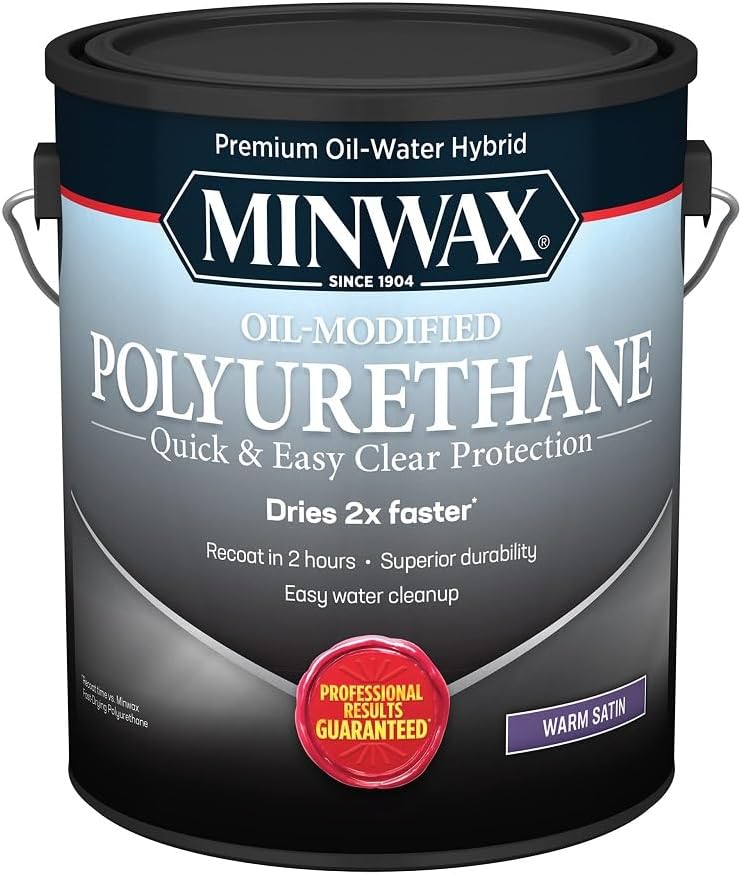
Minwax
$49.95
In stock on Amazon
Check price on AmazonAt-a-Glance Comparison
| Factor | Oil-Based | Water-Based (1K) | Water-Based (2K) |
|---|---|---|---|
| Dry time between coats | 18–24 hrs | 2–4 hrs | 2–4 hrs |
| Coats typically needed | 2–3 | 3–4 | 3–4 |
| Amber color shift | Moderate to strong | Minimal | Minimal |
| VOC level | High (250–450 g/L) | Low–Moderate | Low–Moderate |
| Dry film per coat | ~1.5 mil | ~1.0 mil | ~1.0–1.2 mil |
| Abrasion resistance | High | Moderate | Very High |
| Project timeline | 3–5 days | 1.5–2 days | 1.5–2 days |
Sheen Levels: What Matte, Satin, Semi-Gloss, and Gloss Actually Mean on a Floor
Sheen level is measured in gloss units (GU) — a standardized way of quantifying how much light a surface reflects at a 60-degree angle. The higher the GU, the more mirror-like the floor. Most polyurethane manufacturers offer four standard designations:
- Matte / Flat: roughly 10–25 GU. Hides scratches and dust between cleanings exceptionally well. Popular in wide-plank European white oak installations where the design intent is understated and Scandinavian in character.
- Satin: roughly 35–45 GU. The most common residential choice. Enough sheen to show the wood’s figure and grain without reflecting ceiling lights or foot traffic patterns.
- Semi-Gloss: roughly 55–65 GU. A traditional choice for older homes; reads as “hardwood floor” to most buyers. Shows surface scratches and pet paw prints more readily than satin.
- Gloss: 75+ GU. Rarely specified in residential new construction today. Common in historic restoration where the original finish was high-gloss, and in commercial retail environments where high reflectivity is intentional.
This Old House’s “The Best Polyurethane for Hardwood Floors” makes a point that practitioners should internalize: sheen is not a durability variable. A matte finish is not softer or less protective than a gloss finish — it achieves its appearance through flatting agents added to the same base resin. The hardness of the cured film is functionally identical across sheen levels within the same product line.
Where sheen does affect your decision is maintenance visibility. Higher-gloss floors show wear patterns earlier visually, which can create pressure to refinish sooner even when the remaining film thickness is still adequate. Architectural Digest’s “Hardwood Floor Refinishing Guide” consistently observes that specifiers working on premium species installations tend to favor lower sheens — satin or matte — precisely because those sheens reduce the visual noise of light scratching between refinish cycles.
Species-specific note: On highly figured material — quartersawn white oak (cut so the growth rings run nearly perpendicular to the face, producing a distinctive ray-fleck pattern), figured maple, or book-matched walnut — a matte or satin finish often reads as more intentional than semi-gloss. Semi-gloss can visually flatten chatoyance, which is the depth and shimmer visible in the figure of premium cuts. This is an aesthetic judgment, but it is one experienced specifiers make consistently in favor of lower sheens on high-value species.
Real Cost Per Square Foot: Material, Labor, and the Recoat Cycle
The listed price per gallon of polyurethane is the least important number in this calculation. Here is the framework that actually matters.
Material cost: Quality water-based floor poly at the commercial 2K tier runs roughly $80–$140 per gallon at specialty flooring supply houses as of mid-2026. Coverage rates are typically 400–500 sq ft per gallon per coat. A 1,000 sq ft floor at four coats water-based uses approximately 8–10 gallons: $640–$1,400 in finish material alone. Oil-based products at a comparable quality tier run $50–$90 per gallon with coverage of 500–600 sq ft per coat. A three-coat application on 1,000 sq ft requires 5–6 gallons: $250–$540 in material. Water-based material costs run 2–2.5x higher at the quality tier where the performance gap between the two systems narrows most significantly.
Labor cost: Professional refinishing in the continental U.S. runs $3–$6 per sq ft for sand-and-finish as of 2026, per contractor pricing data documented in Wood Magazine’s “Floor Finish Showdown: Oil vs. Water-Based Poly.” The finish-only portion — assuming the floor is already sanded — is typically $1.50–$3.00 per sq ft. Because water-based allows same-day recoating, a contractor can complete a water-based project in one or two days versus three to five for oil-based, which reduces scheduling overhead and, in occupied homes, directly reduces displacement costs for the homeowner.
By the numbers — 1,000 sq ft, professional finish-only application:
- Oil-based, 3 coats: ~$400–$700 material + $1,500–$3,000 labor = $1,900–$3,700 total / $1.90–$3.70 per sq ft
- Water-based 1K, 4 coats: ~$500–$900 material + $1,500–$3,000 labor = $2,000–$3,900 total / $2.00–$3.90 per sq ft
- Water-based 2K, 4 coats: ~$640–$1,400 material + $1,500–$3,000 labor = $2,140–$4,400 total / $2.14–$4.40 per sq ft
The gap between oil-based and mid-tier water-based is narrower than the material-only comparison suggests, because labor is the dominant cost center in either scenario.
Recoat cycle: Oil-based poly, properly applied at 3–4 mils, is typically maintenance-recoated — screened and given 1–2 fresh coats without a full sand — every 5–7 years in moderate-traffic residential use. Water-based at equivalent mil thickness behaves comparably in controlled conditions. As Fine Woodworking’s finishing coverage notes, the critical variable is product tier: commercial-grade 2K water-based finishes match or exceed oil-based in abrasion resistance, while single-component water-based products in high-traffic areas — entryways, kitchens — may require a full sand-and-refinish at the 8–10 year mark rather than at 12–15 years.
Species Compatibility and the Tannin Problem
If you’re finishing white oak, walnut, or any species with elevated tannin content, finish chemistry interacts with the wood in ways that carry practical consequences.
White oak is high in tannins. Oil-based poly applied directly over bare white oak can produce a greenish or grayish reaction where the tannins contact the solvent — particularly visible on quartersawn material where the ray flecks are exposed end-grain. The standard mitigation is a barrier coat of dewaxed shellac or a water-based sealer before the oil-based topcoats. This Old House’s “The Best Polyurethane for Hardwood Floors” specifically flags this issue for white oak and recommends testing in an inconspicuous area before committing to the full floor.
Water-based poly avoids the tannin-reaction problem almost entirely. This is one of the underappreciated advantages on premium white oak installations: you get a clear, non-ambering finish that shows the natural silver-gray undertone of the species without the tannin-reaction risk.
Walnut presents a different consideration. Its naturally dark, warm tone is enhanced by the amber shift of oil-based poly, which many designers and homeowners actively prefer. Water-based over walnut can read as slightly flat or cool by comparison. Per finishing guidance documented in Wood Magazine’s species finishing coverage, this is the one species context where oil-based retains a clear aesthetic edge in most residential applications.
DIY vs. Professional Application: Where the Calculus Shifts
Water-based is more forgiving on occupant scheduling; oil-based is more forgiving of minor applicator error.
Water-based poly’s faster dry time means application errors — lap marks, bubbles — set more quickly and are harder to correct mid-coat. Oil-based’s longer open time gives an applicator more window to back-brush and fix. However, oil-based’s high VOC output creates ignition risk if a space is not ventilated properly. Oil-based poly application in enclosed spaces requires mechanical ventilation and removal of ignition sources including pilot lights and HVAC sparking components — this is not a minor caveat but a genuine safety requirement.
For a contractor working a 2,500 sq ft floor in a furnished, occupied home, water-based wins the scheduling argument clearly. For a meticulous DIYer refinishing a small bedroom with good ventilation and no time pressure, oil-based’s lower material cost and more forgiving open-time window is a defensible choice.
The Decision Rule
If your floor is white oak, maple, or ash and you’re prioritizing a clean, contemporary aesthetic with minimal amber shift: water-based, 4 coats, satin or matte, commercial-grade 2K product. Budget $2.14–$4.40 per sq ft for finish material and labor combined on a professional application.
If your floor is walnut, cherry, or heart pine and the warm, traditional amber look is the target aesthetic — or if you’re working in a well-ventilated unoccupied space with a longer project timeline: oil-based, 3 coats, satin. Budget $1.90–$3.70 per sq ft combined.
If the project is in an occupied home with children or pets and displacement time is a real constraint: water-based wins regardless of species, because the 24-hour return-to-use timeline versus 72–96 hours for oil-based is a livability factor that overrides most aesthetic preferences.
If budget is the binding constraint and you’re doing DIY on a species without tannin-reaction risk — pine, maple, or red oak — a single-component oil-based product at the entry quality tier delivers adequate performance at the lowest material cost. Respect the ventilation requirements, and do not rush the recoat windows. That is where the majority of DIY application failures originate.
The finish is the last decision and the longest-lived one. On a $15 per square foot white oak floor, spending an extra $0.50–$1.00 per sq ft to match the chemistry correctly to the species and use case is not a premium — it is the math working in your favor.