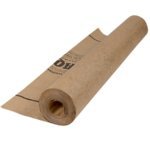
When you’re installing hardwood floors — whether that’s a wide-plank white oak over a concrete slab or solid walnut over a crawl-space subfloor — one of the most consequential decisions happens before a single board goes down. It’s the layer that lives between your subfloor and the wood: the vapor barrier or moisture retarder. These are materials designed to slow or stop moisture (water vapor moving through concrete, soil, or older wood subfloors) from reaching your finished floor. Get this layer wrong and the wood absorbs that moisture, swells, cups (edges lift higher than the center of each board), or worse — develops mold underneath where you’ll never see it until the damage is done. Get it right and your floor performs the way it should for decades. This guide explains exactly what those spec-sheet numbers mean, where each product type belongs, and how to match the right system to your actual subfloor conditions.
Vapor Barrier vs. Moisture Retarder: The Distinction That Actually Matters
The industry uses “vapor barrier” as a catch-all, but the National Wood Flooring Association (NWFA) draws a hard line in their Installation Guidelines: Moisture Control (2023 edition): a true vapor barrier has a permeance rating (called a “perm” rating, which measures how much water vapor passes through a material per hour) of 0.1 perms or less. A moisture retarder sits between 0.1 and 1.0 perms. Anything above 1.0 perm is neither — it’s just a felt underlayment or construction paper.
Why does that number matter? Because concrete slabs and crawl-space subfloors don’t have a moisture problem you solve once — they have an ongoing vapor drive, meaning water vapor is constantly migrating upward through the slab or floorboards from the ground below. A true vapor barrier essentially stops that drive. A retarder slows it. And some floors — particularly engineered hardwood — are actually designed to be installed over retarders, not full barriers, because they need a small amount of vapor exchange to avoid stress cracking from being sealed too tightly.
The practical decision tree:
- Solid hardwood over concrete slab: You need a true vapor barrier (≤0.1 perms) or the manufacturer’s approved adhesive system. Most solid wood species shouldn’t be installed below grade at all — this is a slab-on-grade or above-grade situation only.
- Engineered hardwood over concrete: A moisture retarder in the 0.1–1.0 perm range is typically correct; some manufacturers spec a specific 6-mil poly sheeting or their proprietary underlayment.
- Solid or engineered hardwood over plywood subfloor (crawl space below): A 15-lb asphalt-saturated felt or a 30-lb felt acts as a retarder and a staple-friendly work surface. The NWFA allows felt underlayment in these applications when the crawl space is properly sealed and ventilated.
- Floating engineered hardwood over any subfloor: Follow the floor manufacturer’s spec sheet exactly — many void warranties if you use a vapor barrier when they’ve specified a retarder-class underlayment.
Reading the Spec Sheet: Four Numbers You Need to Find
When you pull up a product data sheet for a moisture control product, here are the four figures that determine whether it fits your project:
1. Perm Rating As described above, this is the headline number. Spec sheets may report it as a ASTM E96 (the American Society for Testing and Materials standard test method) dry-cup or wet-cup result. For flooring applications, look for the wet-cup result — it represents real-world conditions better than the dry-cup test.
2. Mil Thickness One mil = one-thousandth of an inch. A 6-mil polyethylene sheet is the NWFA minimum for below-grade slab applications. For crawl spaces, the NWFA recommends a 6-mil poly ground cover on the crawl-space floor itself, in addition to any underlayment above. Thicker (10–20 mil) products are more puncture-resistant during installation but don’t necessarily have a lower perm rating than a 6-mil sheet of the same material.
3. MVER Limit Moisture Vapor Emission Rate, measured in pounds of moisture per 1,000 square feet per 24 hours (lbs/1,000 sf/24 hrs). Concrete slabs emit vapor; the question is how much. The NWFA standard for most hardwood flooring is 3 lbs or less using the calcium chloride test (ASTM F1869). Some adhesive-based systems and proprietary moisture mitigation coatings are rated to handle up to 8–12 lbs — this is the premium tier of moisture control, used on slabs that fail a standard moisture test but where you’re committed to installing hardwood anyway.
4. pH Tolerance Concrete has a naturally alkaline surface (pH 9–11). Certain adhesives and vapor control membranes degrade in high-pH environments. Spec sheets from quality manufacturers will list the pH range the product tolerates — if your slab tests above 9 pH, confirm the product is rated accordingly. This detail is frequently omitted from big-box product literature and is a reason to source from specialty distributors who carry manufacturer technical reps.
By the Numbers
| Application | Min Vapor Control Class | MVER Limit | Common Product Format |
|---|---|---|---|
| Solid hardwood, on-grade slab | True barrier (≤0.1 perm) | ≤3 lbs/1,000 sf/24 hr | 6-mil poly + approved adhesive |
| Engineered hardwood, on-grade slab | Retarder (0.1–1.0 perm) | ≤3–5 lbs (product-specific) | Roll underlayment or adhesive membrane |
| Solid hardwood, plywood over crawl space | Retarder (15-lb or 30-lb felt) | N/A (wood subfloor) | Asphalt-saturated felt |
| Floating engineered, any subfloor | Per manufacturer spec | Per manufacturer spec | Foam or combination foam/film |
Sources: NWFA Installation Guidelines: Moisture Control (2023); Wood Flooring Manufacturers Association Installation Guidelines.
Where Installers and Homeowners Commonly Go Wrong
Assuming concrete is dry because it looks dry. Concrete is a slow evaporator. A slab that reads visually dry and passes the anecdotal “tape a plastic sheet down and check for condensation” test in winter can fail a calcium chloride test in spring or summer when the water table shifts. The NWFA and the American Wood Council both recommend quantitative testing — not the plastic sheet method — before any moisture control product selection. Calcium chloride test kits (ASTM F1869) and relative humidity in-situ probe testing (ASTM F2170) are the two accepted protocols; the probe method is considered more reliable by most moisture control product manufacturers because it measures average slab moisture rather than surface emission.
Overlapping seams without taping. A 6-mil poly vapor barrier with poorly overlapped and un-taped seams behaves more like a 3-perm retarder than a true barrier. NWFA installation guidelines specify a minimum 6-inch overlap at seams, taped with a compatible seam tape. This is one of those installation details that disappears once the floor goes down — and the consequences don’t show up for 12–24 months.
Using the wrong product for a floating floor system. Floating engineered floors move as a unit — they expand and contract across the whole field of the room. A vapor barrier that creates a slick surface can allow excessive lateral movement, causing gapping at the walls or locking-profile failures. Manufacturers like Shaw, Boen, and Mirage publish approved underlayment lists specific to their locking systems. Per Fine Woodworking’s archived coverage of wood movement mechanics, dimensional stability is a function of both species and the moisture environment the floor lives in permanently — which means the underlayment’s perm class affects long-term movement as much as the original acclimation period.
Conflating crawl-space sealing with subfloor underlayment. These are two separate systems that both need to be correct. A properly sealed and conditioned crawl space (encapsulated with a 10–20 mil vapor barrier on the ground, walls, and piers, with controlled ventilation or dehumidification) dramatically reduces the moisture load on the subfloor above. This Old House’s editorial guidance on crawl-space moisture consistently identifies the ground cover as the primary control point — meaning if you skip crawl-space encapsulation and rely entirely on the underlayment above, you’re fighting a much larger moisture source with a downstream tool.
The Adhesive Membrane Option: Premium Tier, Real Trade-offs
If your slab tests above 3 lbs MVER — which disqualifies most standard vapor barrier underlayments — you’re in the territory of moisture-mitigation coatings or high-MVER-rated adhesives. Products in this category (two-component epoxy membranes, polyurethane adhesive systems) are rated to bond directly to concrete at up to 8–12 lbs MVER while providing a vapor control layer built into the adhesive itself.
The math on these systems is significant:
- Standard 6-mil poly + floating installation: roughly $0.15–$0.30/sq ft for the moisture control layer
- Moisture-retarder-class roll underlayment (premium brands): $0.40–$0.80/sq ft
- Two-component epoxy moisture mitigation membrane: $1.50–$3.00/sq ft installed (materials only, from published distributor pricing as of early 2026)
That cost difference on a 1,000 sq ft project is $1,350–$2,700 in additional moisture control spend — before the floor itself. Whether that’s worth it depends entirely on what the slab tests at and what floor you’re specifying. For a $12/sq ft European white oak from Carlisle Wide Plank Floors or an engineered walnut at $15/sq ft, protecting a $12,000–$15,000 material investment with a $2,000 moisture mitigation system is defensible math. For a $4/sq ft prefinished oak, it changes the calculus entirely.
The Decision Rule
If your project fits one of these conditions, here’s where to land:
-
Slab tests ≤3 lbs MVER, above-grade or on-grade: 6-mil poly vapor barrier with taped seams is compliant for most solid and engineered hardwood installations. Confirm perm class against your specific floor manufacturer’s warranty language before purchasing.
-
Slab tests 3–8 lbs MVER: Move to a manufacturer-rated high-MVER adhesive or a two-component epoxy moisture membrane. Do not install solid hardwood. Engineered hardwood with the right adhesive system is your path.
-
Slab tests above 8 lbs MVER: You have a slab moisture problem that moisture control products alone may not solve. Address the source (drainage, below-slab conditions, hydrostatic pressure) before specifying flooring.
-
Plywood subfloor over crawl space: Seal the crawl space first with ground-cover poly (minimum 6-mil, 10–20 mil preferred). Then use 15-lb or 30-lb asphalt felt under solid hardwood. Confirm the crawl space relative humidity stays below 60% year-round before considering the floor fully protected.
-
Floating engineered over any subfloor: Pull the manufacturer’s approved underlayment list before purchasing anything else. Warranty compliance on locking-profile floors is product-specific, and the spec sheet from the floor manufacturer supersedes any general guideline here.
The vapor control layer is invisible once the floor is down — which is exactly why the spec sheet decisions made before installation determine whether a premium hardwood floor performs for thirty years or fails in three.