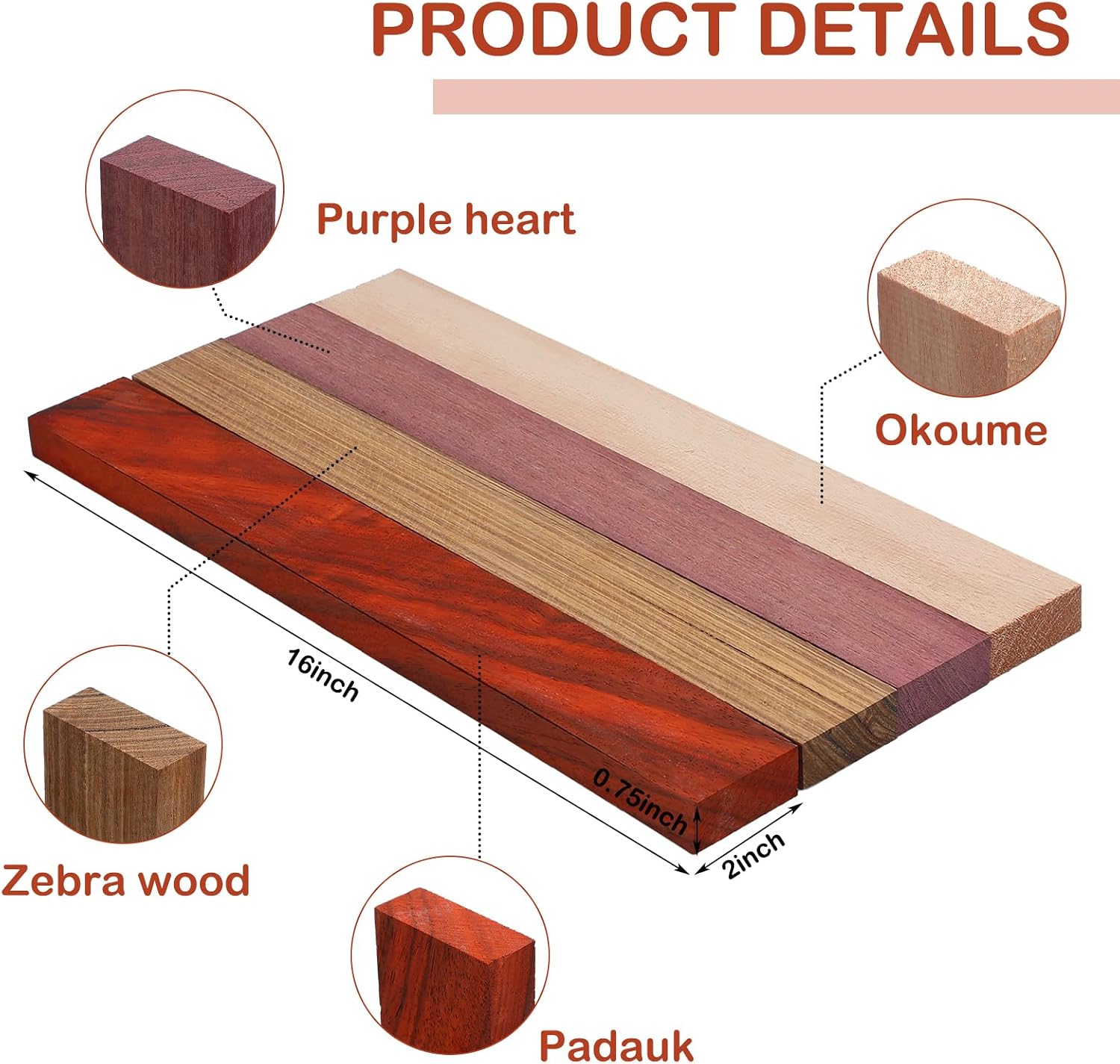
If you’ve ever seen a cutting board with a vivid violet stripe, a guitar body with wild dark-and-cream zebra markings, or a jewelry box glowing brick orange, you were almost certainly looking at purpleheart, zebrawood, or padauk. These are imported exotic hardwoods — species harvested primarily in Central and South America or equatorial Africa, then milled and sold in the U.S. specialty lumber market. Unlike the domestic oak or maple you’d find at a big-box store, exotics are sold by the board-foot (a unit of volume: one foot long, one foot wide, one inch thick — roughly the size of a hardback novel lying flat), and their prices, availability, and finishing behavior differ sharply from each other. This guide breaks down what each species actually costs right now, what the finishing chemistry looks like, and — critically — what the safety risks are that most product pages quietly omit.
What You’re Actually Paying For: Species Prices in Mid-2026
Exotic hardwood pricing is famously opaque. The same species at two reputable dealers can differ by 30–50% based on grade, thickness, and whether the board is figured (meaning it has an irregular, visually complex grain pattern from abnormal wood fiber growth). Here’s where the three species sit as of May 2026, based on published retail price lists from Woodworker’s Source, Bell Forest Products, and Hearne Hardwoods.
By the numbers — retail board-foot pricing, May 2026:
| Species | Typical Range ($/bf) | Figured Premium | Common Thickness |
|---|---|---|---|
| Purpleheart | $8–$14 | +20–35% | 4/4 to 8/4 |
| Zebrawood | $14–$22 | N/A (figure is inherent) | 4/4 to 6/4 |
| Padauk | $7–$13 | Minimal | 4/4 to 8/4 |
(4/4 means one inch thick in rough-sawn form; 8/4 means two inches. Rough-sawn lumber is sold slightly oversized before you mill it to final dimensions.)
Purpleheart (Peltogyne spp.) lands in the mid-range for exotics. Its famous violet color is the main event, but that color is photoreactive — it oxidizes toward a dull brownish-purple when exposed to UV light, which changes the finishing calculus significantly (more on that below). Dealers typically stock 4/4 and 8/4; thicker slabs for table legs or turning blanks run toward the top of the range. Bell Forest Products’ Q2 2026 price sheet lists select-grade 4/4 purpleheart at $10–$12 per board-foot, with figured pieces at $13–$15.
Zebrawood (Microberlinia brazzavillensis) is the most expensive of the three and the most limited in supply. Its dramatic alternating dark-and-light grain isn’t figure in the traditional sense — it’s structural, present in nearly every board, which is why there’s no separate figured premium. However, quartersawn zebrawood (cut perpendicular to the growth rings, which produces a more pronounced, ribbon-like stripe) commands a significant premium over flatsawn. Hearne Hardwoods’ May 2026 inventory lists quartersawn zebrawood at $20–$22 per board-foot; flatsawn runs $14–$17.
Padauk (Pterocarpus soyauxii) is the accessible entry point in this group. It machines cleanly, is widely stocked, and its vivid orange-red color makes it visually competitive with much pricier species. Woodworker’s Source’s current price list shows 4/4 padauk at $7–$10 per board-foot, making it one of the better value propositions in the exotic category.
The sourcing math you need to run: If you’re pricing a project, add 20–30% to the nominal board-foot cost to account for waste — exotic boards often have more character defects (checks, knots, sapwood) in lower grades, and your yield from rough-sawn to finished dimension will rarely exceed 70–75%. On a 20-board-foot zebrawood panel project at $16/bf, your effective material cost before any finishing supplies is closer to $410–$420, not $320.
Finishing Exotic Hardwoods: The Chemistry Differences That Matter
Most general finishing guides treat exotics as interchangeable with domestic species — apply oil, add topcoat, done. That’s the wrong mental model. These three species have distinct finishing challenges, and the consequences of ignoring them range from blotchy results to finish adhesion failure.
Purpleheart: The UV Color Problem and Oil Incompatibility
Purpleheart’s violet color comes from anthocyanin-like compounds in the wood’s extractives. Fresh-cut purpleheart is a vivid grape-purple; within weeks of UV exposure without protection, it shifts toward a brownish eggplant. This isn’t a finishing defect — it’s photochemistry — but it means UV-blocking topcoats are non-negotiable if color retention matters to your client or your project.
The practical protocol, based on finishing guidance from Fine Woodworking’s archive on exotic species, is to apply a dewaxed shellac wash coat first. Purpleheart’s natural oils and resins can interfere with the adhesion of oil-based polyurethane, causing fisheye or adhesion failure. Shellac (dewaxed, meaning the natural wax has been removed) seals the extractives and gives the topcoat a stable surface. Follow with two to three coats of a UV-inhibiting water-based polyurethane or conversion varnish. UV-inhibiting oil-based finishes work but yellow over time, which fights the color you’re trying to preserve.
Avoid penetrating oil finishes (linseed, tung, danish oil) on purpleheart as a primary finish. Fine Woodworking’s exotic finishing guidance specifically flags that the extractives in Peltogyne species can inhibit curing of oil-based penetrating finishes, leading to a tacky surface that never fully hardens.
Zebrawood: Grain Reversal and Surface Prep
Zebrawood’s alternating light and dark bands are also alternating zones of different density and porosity. The dark stripes are significantly harder and less porous than the light ones. When you apply a penetrating finish or a film-building topcoat, the two zones absorb differently, which can create an uneven sheen or highlight the grain reversal in ways that look unintentional.
The standard approach for zebrawood is to raise the grain intentionally, sand back carefully, and apply a sanding sealer or thin wash coat of shellac before your topcoat. This levels the absorption differential between the stripes. Planing zebrawood also requires attention to grain direction — because the light and dark stripes often run in opposing grain directions at the cellular level, you can get tearout on one stripe while the adjacent stripe machines cleanly. Hand-tool users consistently report better surface quality from card scrapers than from bench planes on zebrawood; power-tool users should keep hand-fed thickness planers set to light passes (1/32” or less) and run boards at a slight diagonal to the grain when possible.
Padauk: Bleed-Through and the Orange Dust Problem
Padauk presents two finishing challenges: extractive bleed and dust color contamination.
The red-orange extractives in padauk are highly soluble in water-based finishes. Apply a water-based product directly to raw padauk and you may get color bleed into the finish layer, muddying the topcoat or creating orange tint in adjacent lighter wood if this is a mixed-species project. The solution is identical to purpleheart: a dewaxed shellac barrier coat first, then your topcoat of choice. Oil-based polyurethane over a shellac wash coat performs reliably on padauk, per Wood Magazine’s guidance on allergenic and extractive-heavy species.
The more immediate concern with padauk is its dust. The same vivid orange pigment that makes a finished padauk surface beautiful becomes a pervasive contamination hazard in your shop. Padauk dust stains every surface it touches — bench tops, unfinished stock nearby, even skin and clothing — and it does not rinse out easily. Run dust collection at the source for every operation, not just as a shop ambient system.
Safety and Toxicity: What the Product Pages Don’t Tell You
This is where most buying guides stop short, and where practitioners working with clients or employees need to be fully informed.
Padauk is the most significant sensitizer of the three. The Wood Database’s species entry for Pterocarpus soyauxii documents that padauk is a known respiratory and skin sensitizer — meaning repeated exposure can cause the immune system to become reactive, and subsequent exposures may trigger increasingly severe responses. This is different from acute toxicity (a one-time exposure problem); sensitization is cumulative and often irreversible once established. Dust mask ratings matter here: an N95 respirator rated for fine particulate is the minimum recommended; a half-face respirator with organic vapor and P100 combination cartridges is the appropriate spec for extended sessions.
Zebrawood carries a moderate sensitization risk. The Wood Database notes eye and skin irritation as the primary reported effects, with respiratory sensitization documented in sustained occupational exposure. The same respiratory precautions apply.
Purpleheart is generally considered lower-risk among the three, though extractive contact can cause skin irritation and nausea in sensitive individuals. The Wood Database reports purpleheart’s sensitization profile as mild compared to Pterocarpus species, but that should not be read as a green light for unprotected work.
The Forest Stewardship Council’s certified species guidance also flags a sourcing consideration: zebrawood (Microberlinia brazzavillensis) originates from Central Africa (primarily Cameroon and Gabon) and has faced pressure from overharvesting. FSC-certified zebrawood exists but is less commonly stocked than FSC-certified padauk. If your client or your own practice requires chain-of-custody documentation, ask your dealer explicitly for FSC certification paperwork — “sustainably harvested” language in a product listing is not the same thing as FSC certification.
Decision Rules: Which Species for Which Situation
If your project is a cutting board or food-contact surface, none of these three species is ideal without careful consideration. Padauk’s extractive bleed and sensitization risk make it a poor choice for food contact. Purpleheart and zebrawood are occasionally used in decorative cutting boards (not end-grain food prep surfaces), but check with your finish manufacturer for food-safe certification on whatever topcoat or oil you apply.
If you’re building a statement furniture piece and color is the brief, the decision tree looks like this:
- Vivid, warm orange-red with good workability and budget flexibility: Padauk. Use shellac barrier coat, run serious dust collection, wear respiratory protection.
- Bold graphic contrast with premium positioning: Zebrawood. Budget for quartersawn if stripe clarity matters. Expect to work around grain reversal. Price your material at $16–$22/bf and plan waste at 25–30%.
- Color drama with a cooler, violet tone and a client who understands color shift: Purpleheart. Commit to UV-blocking topcoat or accept that the color will evolve. Skip the penetrating oil finishes entirely.
If your client asks why the purpleheart dining table “went brown” six months after delivery and you didn’t specify UV protection in your finish schedule — that’s an expensive conversation that a $12 can of UV-inhibiting topcoat would have prevented.
The pricing, finishing chemistry, and safety profile of these three species are genuinely distinct. Treating them as interchangeable “exotics” is the mistake that separates a practitioner from a specialist.